Why In-House Legal Needs a Different AI Strategy Than Law Firms

Private practice and in-house legal teams have spent the last two years in the same first wave of generative AI: both saw 15 to 25 percent productivity gains on routine drafting, and both watched hallucinated-citation embarrassments land lawyers in front of judges. A recent Law.com analysis by Alexandra Smyth argues that agentic AI, unlike the chat tools before it, is where the two sides start to diverge for good.
That argument is written mainly with law firms in mind. For the in-house legal teams we work with, the more useful question is what “diverging” actually means in practice.
Two different starting points
The private-practice version of this story runs through the billable hour. Charging by the hour gets hard to defend once AI turns a partner’s day of supervised drafting into minutes of review. That’s a business-model problem, and it’s reshaping how firms structure teams and set rates.
In-house legal doesn’t have a billable hour to defend, so the question lands differently: what does the legal function actually deliver to the business? That question is harder to sit with than the private-practice version, and it deserves a deliberate answer rather than whatever falls out of the first pilot project.
The efficiency trap
Both sides reach for the same first move. A firm uses AI to turn around billable work faster while still billing by the hour, which quietly shrinks the fee without changing what the client actually gets. An in-house team uses AI to handle more requests without adding headcount. Neither is a considered strategy so much as the easiest business case to get approved: “the same work, faster” doesn’t require anyone to rethink how legal fits into the firm or the company.
It’s also the narrowest use of the technology available. The bigger opportunity, on both sides, is legal helping shape decisions earlier, rather than reviewing them after the fact. That’s a change in what the function does, not a speed upgrade to what it already does, and it’s worth building toward on purpose rather than backing into by accident.
Contract intelligence starts at intake, not after the fact
Here’s what that shift looks like outside the abstract. In most in-house legal teams, an incoming contract gets read, sorted, and routed by whoever happens to open the inbox that day: is this an NDA or a SaaS agreement, does it go to Legal Core or IT Procurement, is there anything in it that needs a senior colleague’s eyes before it goes further. That sorting work is invisible until it’s done badly, a high-risk contract sits in a general queue for a week because nobody flagged it on the way in.
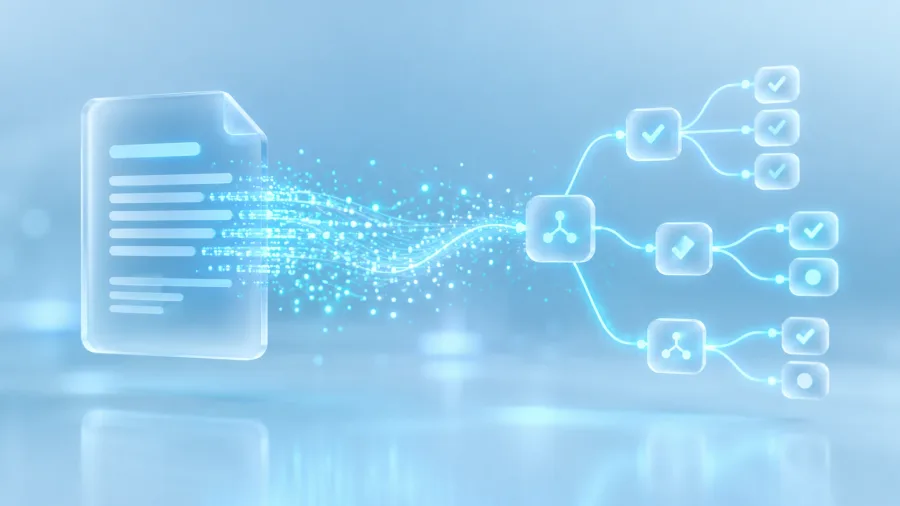
Automating Contract Triage moves that judgment to the moment the contract arrives instead of whenever someone gets around to it. The contract type, the right team, and a risk rating get decided and routed in one pass, before the document has sat in anyone’s inbox long enough to become a problem.
That’s a narrower claim than “AI reviews your contracts for you,” and a more useful one. Nobody reads faster. What disappears is the time lost sorting and routing, because that decision already happened before anyone opened the file, so each person picks up only the contracts that are actually theirs to review.
Trust matters more than model choice
Picking a more capable AI model isn’t what separates a legal team that trusts its AI outputs from one that doesn’t. The models themselves are increasingly a commodity: nearly every legal tool on the market draws from the same small set of them. What actually varies is whether a team knows which outputs it can trust, for which task, and why. That’s the quieter work, and it’s where most AI adoption in legal quietly stalls.
This is where no-code, auditable workflows make the difference. In the same Contract Triage bot, the risk rating isn’t inferred by the model, it’s decided against criteria, liability caps, governing law, contract term length, that the legal team wrote itself and can see and change at any time. That visibility matters more here than in most automation, given how much sensitive contract data is involved.
Pascal Di Prima and Maraja Fistanić get into the same distinction from the builder’s side in a recent Q&A: an agent is a model plus a defined set of tools, and it’s that boundary, not the model, that keeps it from hallucinating.

Watch: “KI-Agenten für Anwälte: So machst du sie schlau” (Q&A in German), Maraja Fistanić and Pascal Di Prima on what makes an AI agent reliable rather than just fast
Starting small without staying small
Starting narrow isn’t the mistake. Staying narrow is. Our Legal Use Case Canvas is a free framework for picking that first workflow: something high volume, repetitive enough to test properly, and low-risk enough that an early mistake gets caught before it costs anything. Contract triage happens to fit that profile, but the framework matters more than any single example. The point is not to stop there. Once a team has proven it can trust a workflow like this one, against thresholds it defined itself, the same underlying pattern extends to other recurring legal work: intake triage for other document types, vendor obligation tracking, compliance monitoring.
Law firms and in-house teams are answering versions of the same underlying question: which work stays with people, and what is the client or the business actually paying for. Because their business models differ, they won’t land on the same answer. For in-house legal specifically, the answer looks less like “review contracts faster” and more like “make the sorting decision once, correctly, before anyone has to open the file.” Much of the interesting potential for in-house teams sits in administrative workflows, information flows between previously disconnected tools, and handling standard requests from other departments.
If Contract Triage looks like a fit, book a walkthrough and see it running with the routing rules and risk thresholds your team already uses.
Frequently Asked Questions
Why do law firms and in-house legal teams need different AI strategies?
Law firms and in-house legal teams start from different problems. Firms are working out how AI affects the billable hour and the training pyramid, a business-model question. In-house teams have no billable hour to defend, so the question is what the legal function delivers to the business, which points toward different priorities and different first automation projects.
What is the most common mistake in-house legal teams make when adopting AI?
The most common mistake is stopping at efficiency: using AI to handle more contracts or requests with the same headcount. It’s the easiest business case to get approved, but it’s also the narrowest use of the technology. The larger opportunity is using AI to help the legal team shape decisions earlier, not just review them faster.
How should an in-house legal team choose its first AI automation project?
Look for a workflow that’s high volume, repetitive enough to test properly, and low-risk enough that an early mistake gets caught before it costs anything. Contract triage is one example that fits this profile. A framework such as the Legal Use Case Canvas helps identify that starting point systematically rather than automating whatever happens to be top of mind. Once a team trusts that first workflow, the same underlying pattern extends to other recurring legal work.
Ready to automate your legal workflows?
Discover how e! can transform your legal operations with no-code automation.